United States of America
The EmigrantsIn The Emigrants, the United States of America is both a geographical destination and a powerful image of another way to live. For Robert, it first takes shape in a book; for Karl Oskar, it becomes a possible answer to poverty, debt, and his children’s uncertain future. Their hopes help turn scattered rumors into a migration movement, but the journey also makes clear that reaching the imagined land requires money, information, cooperation, and the severing of familiar ties.
The country imagined from afar
Before the emigrants have seen it, the United States of America has already acquired a distinct place in their minds. Robert’s thoughts cross the ocean during ordinary work on the farm, and the country beyond it grows in his imagination like a flower taking shape in dark soil. He contrasts an old, exhausted world, where generations repeat inherited lives, with a new one associated with youth, energy, and possibility. This is not knowledge gathered by travel; it is an inward geography built from reading and rumor.
The little book that feeds Robert’s vision is the Description of the United States of North America, which he reads repeatedly and nearly knows by heart. He presents its claims to Arvid as practical information: America is said to offer honest and helpful people, equal standing, and a society without the Swedish divisions between classes. In Robert’s account, neither a king nor a master stands above ordinary people, and work does not bring the same social contempt attached to humble employment at home. These descriptions give the destination moral as well as economic appeal, especially for farmhands constrained by service and local authority.
The novel distinguishes the emigrants’ confidence in such reports from direct experience. Robert relies on a printed guide, while news in the home communities travels by rumor, pictures, and word of mouth; no one there has explored the country for themselves. The New World’s promise is compelling partly because it answers local hardship, but it remains an expectation assembled at a distance. The book’s attraction lies in the work it enables the characters to imagine: labor that might improve their circumstances rather than leave them trapped in the same struggle.
Land, labor, and the decision to leave
For Karl Oskar, the attraction of the United States is closely tied to land. A printed caption claims that farmers willing to work have strong prospects there, and the idea becomes urgent as he weighs life at Korpamoen. He believes that fertile, stone-free soil can be obtained for little, whereas what the family cannot afford at home may be within reach in North America. He does not assume that work will be easy: he considers that it may involve as much toil as in Sweden. The difference, as he sees it, is that work might bring improvement, hope, and a better future for his family.
The decision is also shaped by what Karl Oskar fears for his children. He and Kristina do not want them to become farmhands or crofters, yet he sees no third option for those who cannot inherit a farm. Emigration is therefore not simply a pursuit of personal adventure: it is a response to limited land and livelihoods, and an attempt to change the prospects passed on to the next generation. He reasons that selling Korpamoen, with its possessions and livestock, could pay for the family’s passage and leave a little for settling in the new country.
America’s political promise reinforces the economic one. Karl Oskar understands it as a place where the old social classes have been abolished, where a President is elected by the people, and where neighbors have equal rights to speak at community meetings. He contrasts that picture with the power of officials and the insecurity of Swedish farmers who can lose their possessions to authority. These are the beliefs that inform his choice, not a guarantee that the society he reaches will match every report.
Kristina’s agreement comes after Anna’s death. For a long time she has opposed risking the children on an ocean voyage, but the loss changes her understanding of danger: she recognizes that her children are not safe from death even on dry land, despite her care. She tells Karl Oskar she is willing to entrust them to God and go with him. The couple agree to seek passage the following spring. The decision determines not only their own course but, as the narrative emphasizes, the future birthplace of descendants not yet born.
From information to a collective passage
Information alone cannot carry anyone across the ocean. Robert knows that passage from a Swedish port to New York, including provisions, firewood, and fresh water, costs 150 riksdaler for an adult; with entry and other expenses, he estimates about 200 riksdaler per emigrant. He has that amount through his inheritance, held by his brother at Korpamoen. Arvid, by contrast, has saved nothing: the same fare would take five years of wages. Their exchange exposes the uneven ability to turn the shared dream into actual movement. Robert’s reading offers a route forward, but savings determine who can take it.
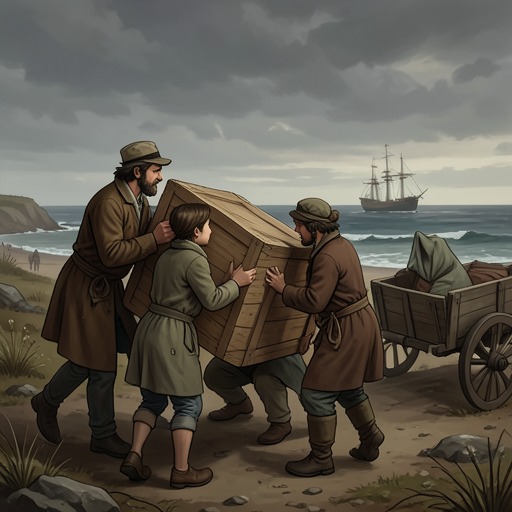
The Nilsson family’s preparations give the destination a material presence before they arrive. Their old oak clothes chest, long kept in the attic and used across generations for belongings associated with weddings and funerals, is brought down and repurposed as an America chest. It is not merely a container: an object that has followed the family through the cycles of life is now to carry its possessions into a new country. Tools, hunting equipment, and fishing gear go inside, along with the means of work that the emigrants expect to need there.
Packing also records what cannot be carried. Kristina chooses wool cards, knitting needles, shears, and a swingle painted with red flowers by Karl Oskar, but must leave behind larger implements that have been part of her working life. Bedding and the bridal quilt are packed, while a food basket is prepared for the road with bread, butter, honey, cheese, smoked meat, and salted fish. The chest therefore holds both practical equipment for beginning again and selected objects of home; the limits of its space make departure a series of choices about what may accompany them.
The route becomes a group undertaking through relationships and arrangements. Karl Oskar and Robert write to a firm in Karlshamn and secure a place aboard the merchant ship Charlotta, with a down payment for six people; Robert offers to obtain a passage contract for Danjel’s party if the ship has room. Danjel knows little about the country he is joining: Robert explains its location, the ocean distance, and the uncertain length of the crossing. Danjel, in turn, trusts that divine guidance will bring favorable winds. The difference between the boy’s practical account and the older man’s faith becomes part of how the group imagines its passage.
At Åkerby Junction, the separate plans converge. Danjel’s party travels with his wife, children, and Ulrika of Västergöhl; Jonas Petter drives another wagon, and Arvid and Elin ride with him. Robert joins Arvid there, so the two farmhands who had imagined a secret departure from Nybacken instead travel alongside a larger company. Nineteen people meet, including drivers who will return from Karlshamn; sixteen are emigrants, nine adults and seven children. A shared route has emerged from different household decisions, unequal resources, and overlapping ties.
Departure and the weight of home
The departure is framed as a passage away from the known rather than an immediate arrival in freedom. When the wagon leaves, Karl Oskar looks back at his parents standing together on the porch, his father stooped on crutches and his mother upright beside him. He remembers them as motionless figures left behind as the young travel onward. The image fixes the cost of the decision in a particular place and gesture: the family’s future journey begins with a sight of those who cannot go with them.
Robert gives the road its own small ritual. At each gate he jumps down to open it and counts the openings as gates on the road to America, including pasture entrances that are standing open for the season. The repeated action turns the route into a sequence of thresholds: each gate is another passage away from the farm life he has known. Meanwhile Karl Oskar and Kristina watch familiar places in silence, aware that they may never again see them as they do now. The hoped-for destination does not erase attachment to home; departure sharpens it.
In the harbor town, the emigrants confront water with no land visible on the other side. The sea they must cross is no longer an abstraction in a guidebook or conversation but a physical divide between departure and arrival. Later, the captain uses Swedish earth carried aboard for a sea burial, scattering three scoops over the dead. In that ritual, the homeland is present on the voyage as material soil, yet some of it slips from the burial cloth into the water. The episode gives the migration’s promise a sober counterweight: the crossing carries people and memories toward a new beginning, but it also exposes them to loss and to the uncertainty of a passage they can make only once.